A large portion of the internet revolves around content marketing. Everything we consume daily—from videos to blogs—falls under this broad spectrum. So what exactly is content marketing? And how do you use it to your advantage in 2025?
What Is Content Marketing?

Content marketing is about creating and sharing valuable information that attracts your target audience. Instead of pushing products directly, you provide useful content that builds trust and authority in your industry.
For example; a law firm posting legal articles on their website can educate and potentially attract clients. Content marketing also comes in many different forms, and the best practices involve a mix of various types.
Different Types of Content Marketing
Blogs and Articles

Blogs and articles are one of the most common types of content on the internet. While both terms are used interchangeably, blogs are actually shorter and more casual, while articles tend to be more in-depth and formal.
Both are highly effective as they inform and educate your audience through written text. By targeting keywords that can drive organic traffic to your website, blogs also play a large role in SEO.
Social Media

Social media content includes posts, stories and videos shared across social media platforms. This includes Instagram, Facebook and TikTok to name a few. Social media marketing also complements other strategies by repurposing content from your website.
For example, a blog post can be turned into an informational Instagram post or a YouTube video can be cut into shorter clips for TikTok. Ultimately, social media content can build brand awareness and drive more traffic to your website.
Video

Our natural preference for visual information makes video content highly engaging. Videos combine imagery and auditory elements that help us break down information faster.
Most people find this much more captivating than reading a blog or looking at an image. Videos also come in many different forms, including short-form clips on TikTok and Instagram Reels, or long-form tutorials on YouTube and webinars.
Each format serves a different purpose—short clips are great for quick engagement, while longer videos are perfect for showcasing expertise.
Infographics

Infographics are a type of digital poster. They present information using a mix of visuals, text and icons, making it easier for audiences to digest complex topics quickly.
Infographics are highly shareable across social media and can also be embedded in blogs or landing pages to boost engagement. They work best for presenting statistics or comparisons in a way that is both informative and visually appealing.
A well-designed infographic can attract backlinks, which also supports your SEO efforts.
Email Marketing

Email marketing is one of the top ways to connect with your customers and drive sales. This form of content marketing is more direct, as it allows you to send messages to your audience’s inbox.
It can be used to share newsletters, promotions or even educational content. It also has measurable results like click-through rates and conversions. Nonetheless, there is the risk of your emails being marked as spam if they are too frequent or irrelevant.
Podcasting

Podcast marketing is a more recent trend. This one allows you to engage listeners with both audio and video formats. Podcasts are great for storytelling and in-depth discussions that provide value to your audience.
They are also convenient, as people can listen while doing daily tasks. The idea is to find a topic that resonates with your audience. Contrary to popular belief, a podcast doesn’t need to have a guest but it’ll definitely add more credibility if you do.
White Papers
White papers are the more formal side of content marketing. They provide research-based insights into a specific topic, often backed by data and analysis. Unlike blogs or social media posts, white papers are designed to be comprehensive and authoritative.
They are often used in B2B marketing to showcase expertise and solve industry problems. White papers also work well as gated content, meaning users exchange their contact details to access them.
Why Is Content Marketing Important?

- Content Engages Your Target Audience Directly: Your content has the potential to directly engage an audience. This means you’re not interrupting them with ads they didn’t ask for. Instead, you’re providing something they’re actively looking for.
When people discover content that answers their questions, they are more likely to stay on the page and explore your brand. - Content Establishes Trust Among Your Customers: Your content can be the difference between gaining trust or losing a customer. This is due to how sacred information can be, and dishing out poorly researched content can damage your credibility.
On the other hand, providing accurate, helpful information will establish trust among your customers. - Content Educates the Public: Content teaches people about your industry. This can help them make informed decisions when it comes to purchasing your service or products.
It also makes your brand more approachable, as you’re seen as a source of knowledge rather than a business pushing sales. - Content Plays a Large Role in SEO: Search engines play a large role in this day and age. With most people starting their research on Google, your content becomes the key to being discovered.
The higher you rank, the more visibility and organic traffic your website will receive. Consistent, optimised content also signals to search engines that your site is credible and relevant, which strengthens your online presence. - Content Is Cost-Effective: You spend much less creating a blog post compared to running paid advertisements. While ads stop working the moment you stop paying, content continues to bring value over time.
A well-written blog or video can keep attracting traffic, leads and sales for months or even years after it’s published. With that said, combining organic content and paid ads is actually a great strategy.
The former gives you long-term visibility while the latter provides immediate reach.
Creating a Content Marketing Strategy
- Define Your Goals: Set your goals and objectives by identifying what you want to achieve with your content. This could be increasing brand awareness, generating leads or boosting traffic.
These goals will guide your strategy and help you measure success effectively. - Know Your Target Audience: Before creating content, you need to know who you’re speaking to. Research your audience’s demographics, interests and online behaviour. The better you understand them, the easier it becomes to craft content that resonates.
- Choose the Right Content: Not every format will suit your business. Decide whether blogs, videos, podcasts, infographics or email newsletters work best for your audience and industry. A mix of formats often works well to cover different preferences.
- Plan Your Content Calendar: Consistency is key in content marketing. A content calendar helps you stay organised, ensuring that you publish content regularly and at the right times. It also allows you to balance evergreen content with timely, trending topics.
- Measure and Improve: Measure how well your content is doing across all platforms. With the help of analytics, you can track metrics like traffic and bounce rates. From there, you can refine your approach and make improvements to your content.
The State of Content Marketing in 2025
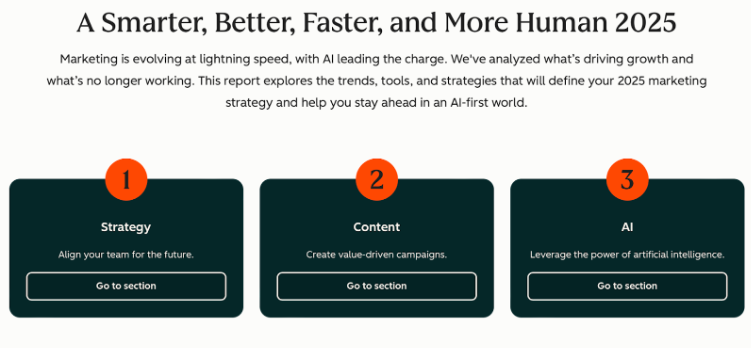
According to Hubspot’s State of Marketing Report, marketing is evolving at a rapid pace with AI leading the way. It’s no surprise that AI like ChatGPT continues to heavily influence the marketing landscape, especially since its inception in late 2022.
Creating content has never been easier but that doesn’t mean AI content is perfect by any means. AI content does fall into the category of “generic content”, as it lacks the unique perspective humans have. On that note, humanising your AI content is more important than ever.
This gives you the speed of AI and the distinctiveness of human content. It’s also worth noting that millennials and Gen Z’s make up the largest groups of digital consumers. Your content should be tailored to these age groups, but don’t neglect older demographics either.
When it comes to content preference, short-form videos and influencer collaborations tend to deliver the highest ROI. This shows how much audiences value bite-sized content and influencers they can relate to.
Conclusion
The phrase “content is king” is not an overstatement. Content marketing has and will continue to play a large role as long as the internet exists. It “makes the internet go round” if you think about it, and your business is smack dab in the middle of it all.
So don’t neglect the power of content marketing, because good content can be the difference between success or failure.
Visit weave.asia or contact us to find out more!